Friday, November 2, 2012

Disaster Prep and Hurricane Sandy


1. News you can use
Hurricane Sandy has devastated the east coast. Although Oklahoma was unaffected, we are third in the nation for the number of declared disasters. We have to be ready.

2. How can we react?
Stories of suffering filled the news. Hurricane Sandy caused people to snap into survival mode. People couldn't get down flights of stairs in the pitch black (no flashlight); no clothes, nothing to eat. etc. A three-day emergency kit can help in times of survival.

3. Housing picture
Eight counties are piloting the EDEN curriculum. We have held focus groups as part of the process. One thing that came to light: You don't have to spend a bunch of $ to be better prepared. Shop for supplies in your own home! Trade with your friends!  Here is a picture of Jessica Riggin as she began to get her supplies together.


4. Anything else I can think of that might help you in your work.
Take the Extension educators preparedness challenge! Please, all of you, shop in your own home and put your own kit together. We can lead by example! Please put your kit together by next Friday, November 9, 2012. I want to give a prize, but I can only do so if at least 20 educators participate. Please… get a kit together! The best photo entry will receive an awesome Red Cross Emergency radio! 

To enter to win, all I need is a picture of you and your kit with a brief description.

Resources:
  • EDEN preparing a kit video: http://www.ag.ndsu.edu/media/eden/getakit.html
  • FEMA recommended supplies: http://www.ready.gov/basic-disaster-supplies-kit

 THANK YOU!

Gina Peek

Friday, August 24, 2012

High Efficiency: Gale Mills Guest Blogger


This week I am introducing Gale Mills as my guest blogger! Gale is located in Washington County, NE District. Gale has recently bought a new high efficiency (HE) washing machine, and is getting used to it.


Here are her comments on the machine thus far:
Was gone on vacation all of last week had loads of laundry when I got back.  It does cause the clothes to be extremely wrinkled, much more than the traditional washer. I also see some dirt residue at times left on the clothes.  Still wonder how clean they are. Really not crazy about it also takes about an hour for each load to finish and the towels are just as wet as with the older washer.  Have problems with towels getting musty smelling and can’t get it out.

Where does this fit in the Issue Teams?
Environment! The new high efficiency machines are designed to use fewer resources. Yes, they do take some time getting used to and the directions must be followed carefully. They use LESS water, energy, and detergent.

One of the keys to the HE machines is using the right detergent and the right amount of detergent. Using wrong detergent or amount of detergent can actually redeposit soils back onto the clothing, so they are not getting cleaned at all. Click here to see a great resource from the Cleaning Institute about HE machines: http://www.cleaninginstitute.org/assets/1/Page/HE.pdf .

Gale and I want to know...

Thanks!
Gina Peek and guest blogger Gale Mills

Thursday, August 9, 2012

Wildfires

Welcome guest blogger Susan Routh! Susan (Grady Co) responded to my note from Sunday. I saw her yesterday at the ABCD in-service and asked her to share her story. Here it is:


Ninnekah Fire:
The Ninnekah Fire was discovered approximately 2:30 p.m. on Friday, August 3rd, south and east of Ninnekah.  In the end, 9,600 acres were burned and one house and one barn were destroyed.  


The homeowners that lost their home are active agriculture producers in Grady County and she is a 50 year member of OHCE. We have been told that the firefighters evacuated many homeowners on Friday evening in that area and the homeowners were not allowed to return until Saturday morning where they saw first-hand the damage.

We have been told of some of the challenges that producers had when trying to negotiate through county roads to get to their homes or pastures during the fire. 
Note from GP: I am working on materials about how to protect your home. These are dangerous times.


The Ninnekah community has been very supportive. The first fundraiser is planned to help repair firefighting units on August 19th with a Bar-B-Que dinner. Additional fundraisers will be held to support this family who lost their homes. It is small community who cares for its residents.


Thank you, Susan for the story and the photos. We are all thinking of those who have suffered. The materials that Ag Comm is helping put together will address MANY of the topics touched on here.


As a reminder, weather radios aren't just for weather. The radios will alert you to emergencies within the specified radius. This means if parts of your county are being evacuated, you'll hear about it on your radio. I am going to refer to them as emergency radios from now on in order to emphasize this point.

Issue Teams
We want to prepare Oklahomans for all kinds of disaster and reduce risk. Where does this fit into Issue Teams? The first five people to tell me exactly what issue team and the measurable outcome fits this topic will be entered into a drawing to win a Red Cross emergency radio. Please explain your answer and give one action you think consumers would be willing to take to meet the measurable outcome.

More next week...

GPeek

Friday, July 27, 2012


Hello Educators!
It is the busy summer season! I know that everyone is having a great time with events like 4-H round up, fairs, OHCE meetings, etc. I wanted to tell you about a recent event and an Environment Issue Team OUTCOME! Please note that we don't have FCS educators on the team right now. Even so, this is an excellent project and can SPARK ideas in other counties.

EVENT: 4-H STEM Institute (June 27-28, 2012)
This is the event that Jeff Sallee coordinates. In 2011 and 2012, I helped to coordinate and teach the iGreen track. Basically, the iGreen track is all about water, energy, and waste.
This year, we had a GREAT group from Haskell County. It was two 4-Hers and an adult volunteer, none other than Rachel Lockwood's husband. Ron was a great adult volunteer!

Jeff Sallee kicked it off by inviting the kids to the free (no county travel dollars used) STEM institute and has secured the funding for the project.


Picture 1. Ron Lockwood learning about Low Impact Development in the hot sun!


Picture 2. Learning about water resources at the OSU Botanic Garden.

Haskell County is interested in iGreen's water tract. the 4-Hers are pursuing a Low-Impact Development (LID) project. A site on the courthouse grounds has been identified, and the group is continuing to gather support on the county level. They were able to receive funding from Dr. Sallee to implement their project, and are working on their budget. This team is has gotten help from Stillwater, including Ag faculty Jason Vogel and Scott Frazier, Kim Toscano from the Bot. Garden, and me. This project really does go across content areas, and is a great example of how Ag and FCS can effectively partner!

Picture 3. Project sketch


UPDATE:
The team is adding recycling bins like the one pictured here:


I am very excited about this project because we can get to some Environment Issue Team outcomes.  The medium term action: Increase the number of Oklahomans who maintain, conserve and protect natural resources (air, land, water). The ultimate outcome: Oklahomans will prevent/decrease the degradation of their environments.

We will be holding an Environment Issue Team in-service at the Haskell County site (after fair season is over). If you are interested in attending, please let me know! Questions? Comments? Please let me know!

GPeek


**Update: Carol Vandiver has been awesome working with Haskell Co. to get supplies ordered and even had everything delivered to the office. It is all coming together!

Friday, June 8, 2012

New Program: Simple Home Repairs

News you can use
I've developed a new program at the request of Lynne Beam, Lana Stidham, Lindsay Ensley and Tracey Watts. It's called Simple Home Repairs.


Housing question of the week: How can I access Simple Home Repairs?
Please let me know if you'd like to use it. I have it stored in a DropBox folder. I'll grant you access to the PPT, teaching guide, and Safety Evaluation.

If you do the program, please give me feedback! I am open to comments and suggestions.


Where does this information fit on the ISSUE TEAMS?
I am going to include Simple Home Repairs under Safety, as many injuries/accidents happen at home. Maintaining property is a primary way to reduce risk.


Housing picture
This is a picture of cracked bathroom tile. The tile cracked as a result of the recent earthquakes

It's proactive to be watchful, looking for subtle signs of damage. Checking these little problems can prevent major headaches later!


Anything else I can think of that might help you in your work
This summer, I am bursting at the seams with programming ideas. I am working on the OHCE state lesson, 7 Steps to a Healthy Home. Here is what you will get: Seven 15 min. leader lessons. You can pick the topic you'd like to cover in the desired 15 minute format.

Stay tuned!

GP

Friday, June 1, 2012

Preventing Falls + Safety Issue team


News you can use
My neighbor, Ms. Ruth, is 97 years old. She wanted to remain in her house. She lived independently, with regular visitors.

We came back from New Mexico, to the news that Ms. Ruth had fallen in her garage, and had laid there for some untold time until the neighbor found her. She was life flighted to Tulsa, where she remains in a medically induced coma. I know that Ms. Ruth wanted to stay in the home peacefully, and not be forced out as a result of a terrible accident.


Housing question of the week 
Research shows that people want to remain in their homes. As we age, our housing needs change. What no-cost and low cost actions can people take to reduce the risk of falls? Stay tuned for a new leader lesson!

Where does this information fit on the ISSUE TEAMS?
Falls prevention via basic home modification is a perfect fit for the safety issue team.  

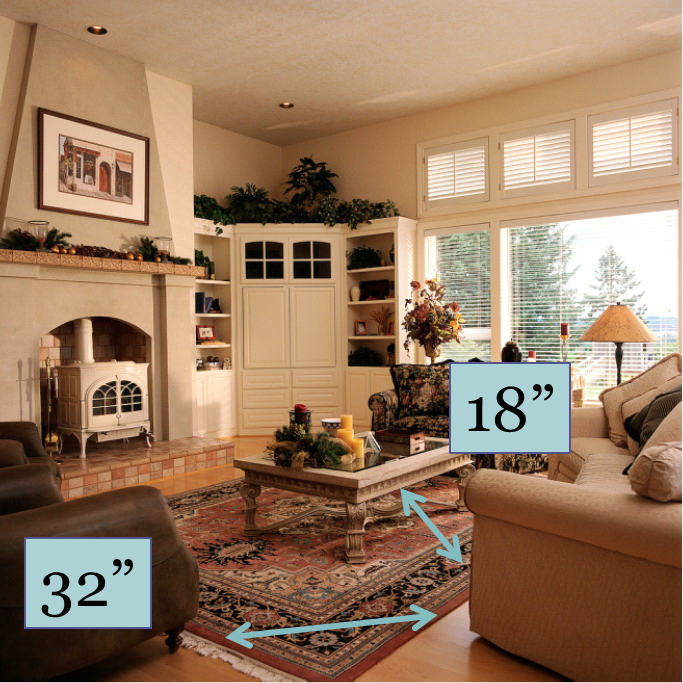
Housing picture


See the measurements on the photo?
  • 32”: Refers to how much clearance you should have to enter a seating area in addition to being comfortable for people walking through, 32” is wide enough for a wheelchair to pass through
  • 18”: Refers to how far a coffee table, if you choose to have one, should be placed from a seating area such as a sofa. 18” is wide enough to let a person walk through, but not too wide for accessibility purposes

Anything else I can think of that might help you in your work.
I have been focusing efforts on home safety lately.
  • Leilana (Ag Comm) has developed some falls prevention news releases
  • Check out the new Research Brief about Older Adults' Opinions on Housing
  • I am also going to make a 15-minute leader lesson about spacing furniture to reduce the risk of falls. Please share a story. I will incorporate it into the Leader Lesson. If you've got a picture, that's even better!


    Please stay tuned! 

    Thank you!
Thanks you!

Friday, May 18, 2012

CDC redefines lead poisoning level


News you can use
I was initially going to focus this blog on a lot of random (yet good and compelling) stuff that has come my way recently.

I changed my mind yesterday when I received news that the US Centers for Disease Control and Prevention (CDC) has changed the blood lead level from 10 micrograms per deciliter to 5.

Housing question of the week: Why should we care about CDC changing lead levels?
This is the first time in 20 years that CDC has changed the definition of lead poisoning.

When we are talking about 5 micrograms per liter, we're talking about very small amounts. These very small amounts can do great harm. Lead is a neurotoxin, and can affect everything from the ability to pay attention to death.

Lead poisoning is preventable.

The only way to know if someone has elevated blood lead levels is to test. 


Where does this information fit on the ISSUE TEAMS?
I am going to put lead poisoning prevention under safety. I see lead poisoning prevention fitting in well to the safety team, that is, reducing risk. It's all about healthy housing.

Since I am on Issue Team Safety and Issue Team Environment, I'd like to see some measurables from these areas. Of course, there is always unplanned time.


Housing picture
Janna Kelley (Pontatoc Co) recently sent me these photos, inquiring about mold. To make a long story short, there was a pregnant woman that had moved into the home, and was concerned about the mold.

Now, I can look at this house and see the following:
  • It was built before 1978 (I can tell by the style)
  • The window is painted (friction/impact surface)
  • The window is compromised


The first person who can correctly explain (in the context of today's blog) why this concerns me receives a healthy homes tool of my choice.


UPDATE:
The winner is Dr. Atiles! The answer he provided is the best because he mentioned the pregnant woman and dust. Pregnant women that ingest lead pass it to the fetus. Most lead poisonings are caused by lead dust that you can't see.


Here is his response: You have deteriorating paint off the window and window sill which must likely is lead paint and the lead dust will harm the pregnant mother blood stream that feeds the fetus and will likely create a problem in the child's brain (nervous system).


The second runner up is Jan Maples! Dr. Atiles is donating his prize to Jan. Congrats to both of you!


Anything else I can think of that might help you in your work.
  • I am going to work with Leilana to do a news release about this. In the meantime, if you want more info, please visit the Institutes of Health release http://www.nlm.nih.gov/medlineplus/news/fullstory_125245.html.
  • There is a GRANT opportunity focusing on veterans. Many returned veterans have ... you guessed it! Young children. If you would like to pursue this, please let me know.


The Home Depot Foundation, a philanthropic vehicle of Home Depot, has announced that it is accepting applications for its Community Impact Grants Program from nonprofit 501(c)(3) organizations, public schools, and public service agencies in the United States that are using the power of volunteers to improve the physical health of their communities. Given the realities of the current housing market, the foundation is prioritizing projects that help military veterans stay in their homes comfortably. More competitive grant proposals will specifically identify projects for veterans and will include housing repairs, modifications, and weatherization work. Proposals for the following community improvement activities will be considered: repairs, refurbishments, and modifications to low-income and/or transitional veteran's housing, or community facilities (schools, community centers, senior centers, etc.); weatherizing or increasing energy efficiency of low-income and/or transitional veterans' housing, or community facilities; and planting trees or community gardens and/or landscaping community facilities that serve veterans. Grants must support work completed by community volunteers in the U.S. Only registered 501(c)(3) nonprofit organizations, tax-exempt public schools, and tax-exempt public agencies in the U.S. are eligible to apply. Grants of up to $5,000 will be made in the form of Home Depot gift cards for the purchase of tools, materials, or services. August 13, 2012 is the deadline.


That's all for now ... thank you!

GP